
Evaluation Fausto Pirandello
Fausto Pirandello Valuations - Want to sell a Fausto Pirandello piece? Request a complimentary and confidential valuation!Casa d'Aste Arcadia will review your submission and offer a free-of-charge estimate, if your item is suitable for our auctions.
biography
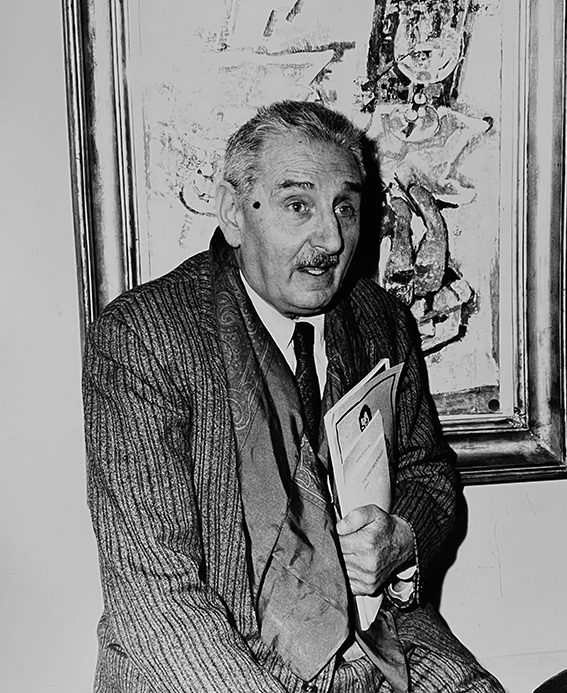
Fausto Pirandello, born in Rome in 1899 and died in the same city in 1975, was an important Italian painter and one of the leading figures of the Scuola Romana. The son of the writer and dramatist Luigi Pirandello and Maria Antonietta Portolano, he grew up in a highly cultured environment, but soon chose to devote himself to painting, focusing his training on drawing and on the direct study of reality. His artistic path belongs to the core of 20th-century Italian art, shaped by expressive research, attention to pictorial matter, and a highly personal, independent vision of figurative language.
After a brief experience in Paris, Fausto Pirandello came into contact with the major European artistic currents of the 1920s and 1930s, approaching the painting of the so-called Italiens de Paris, surrealism, and above all the work of Pablo Picasso, with whom he developed a comparison that would leave a mark on his mature style. Back in Rome, he developed a recognisable style based on an honest representation of reality, often focusing on its harshest and least reassuring aspects. His painting is distinguished by the use of dense, thick pictorial matter, capable of rendering bodies, interiors, and everyday scenes with strong plastic intensity.
Throughout his career, Fausto Pirandello took part in numerous exhibitions and group shows in Italy and abroad. His first solo exhibition dates to 1929 at the Galerie Vildrac in Paris. In the following years he exhibited in several important venues, including the Galleria della Cometa in 1938, the Galleria di Roma, and Ettore Gian Ferrari’s gallery in Milan in 1942, beginning a collaboration that would last for the rest of his life. His activity remained steady and widely recognised after the war, when additional awards and honours arrived.
In the 1960s he received important accolades, including the Premio Michetti in 1964 and the Premio Villa in 1967. Fausto Pirandello died in Rome in 1975, leaving a major artistic legacy in the history of 20th-century Italian painting. Today he is remembered as an original artist, linked to the Scuola Romana yet capable of developing an autonomous voice, still central to critical studies, scholarly research, and the art market, including the attention of auction houses such as Arcadia.
After a brief experience in Paris, Fausto Pirandello came into contact with the major European artistic currents of the 1920s and 1930s, approaching the painting of the so-called Italiens de Paris, surrealism, and above all the work of Pablo Picasso, with whom he developed a comparison that would leave a mark on his mature style. Back in Rome, he developed a recognisable style based on an honest representation of reality, often focusing on its harshest and least reassuring aspects. His painting is distinguished by the use of dense, thick pictorial matter, capable of rendering bodies, interiors, and everyday scenes with strong plastic intensity.
Throughout his career, Fausto Pirandello took part in numerous exhibitions and group shows in Italy and abroad. His first solo exhibition dates to 1929 at the Galerie Vildrac in Paris. In the following years he exhibited in several important venues, including the Galleria della Cometa in 1938, the Galleria di Roma, and Ettore Gian Ferrari’s gallery in Milan in 1942, beginning a collaboration that would last for the rest of his life. His activity remained steady and widely recognised after the war, when additional awards and honours arrived.
In the 1960s he received important accolades, including the Premio Michetti in 1964 and the Premio Villa in 1967. Fausto Pirandello died in Rome in 1975, leaving a major artistic legacy in the history of 20th-century Italian painting. Today he is remembered as an original artist, linked to the Scuola Romana yet capable of developing an autonomous voice, still central to critical studies, scholarly research, and the art market, including the attention of auction houses such as Arcadia.
Past lots of Fausto Pirandello

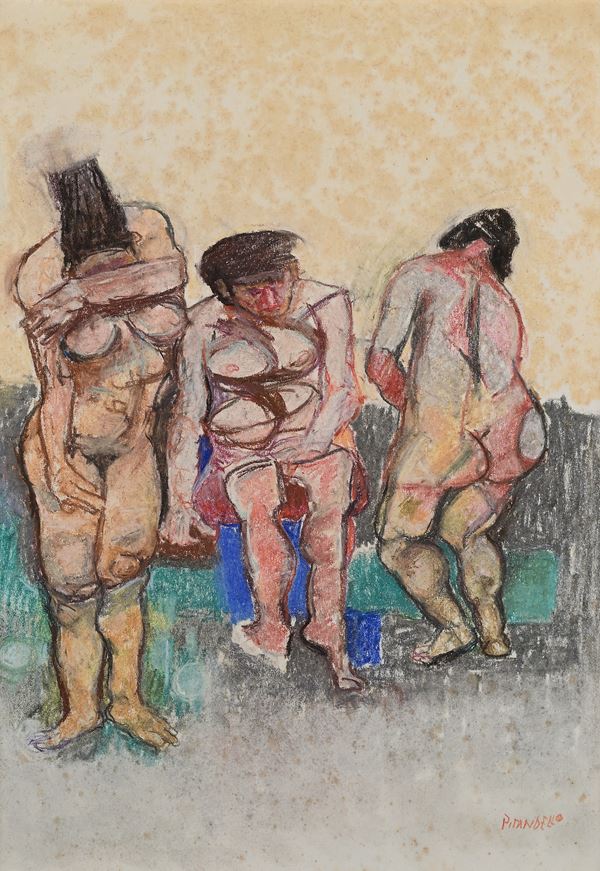
Fausto Pirandello
(Roma, 1899 - Roma, 1975)
Nudo disteso
Firma in basso a destra "Pirandello". Al verso etichetta parzialmente conservata della XXV Esposizione Internazionale Biennale [..]
Sold
Fausto Pirandello©
(Roma, 1899 - Roma, 1975)
Composizione con zucca
Firma in basso a destra "Pirandello". Al verso reca timbri della Galleria Lisi (Roma); Galleria Volos (Roma); Galleria G. [..]
Sold
Tuffatori
Tuffatori
Olio su tavola, cm 73x100
Firma in basso a sinistra "Pirandello"
Opera accompagnata da certificazione [..]
Sold
Portrait of Mimì Costa
Signed "Pirandello" on the lower left front. On the reverse it bears the words "Sironi".
Sold
Fausto Pirandello©
(Roma, 1899 - Roma, 1975)
Bagnanti
Firma in basso a destra "Pirandello" Pastelli su carta cm 21x27 - in cornice cm 41x47
Sold
Bagnanti
Firma in basso a destra "Pirandello" Pastelli su carta cm 26x20 - in cornice cm 45x39
Sold
Fausto Pirandello©
(Roma, 1899 - Roma, 1975)
BAGNANTI
BAGNANTI - pastelli e matita su carta, cm 28x22. Firma sul fronte "Pirandello". Sul retro timbro della Galleria [..]
Sold
Fausto Pirandello©
(Roma, 1899 - Roma, 1975)
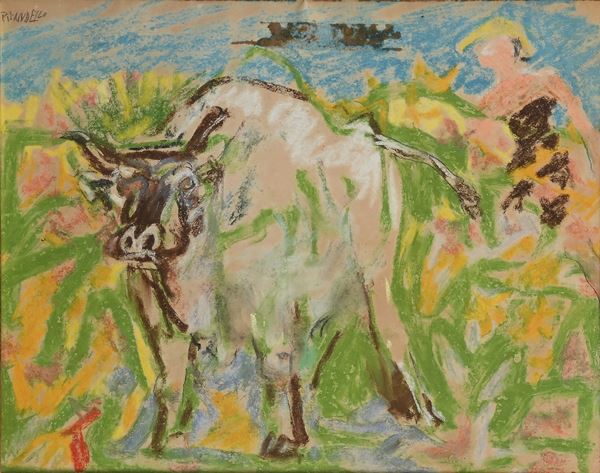
Toro
Firma in alto a sinistra "Pirandello" Pastelli su carta cm 22,5x28,5 - in cornice cm 43x48
Sold
Fausto Pirandello©
(Roma, 1899 - Roma, 1975)
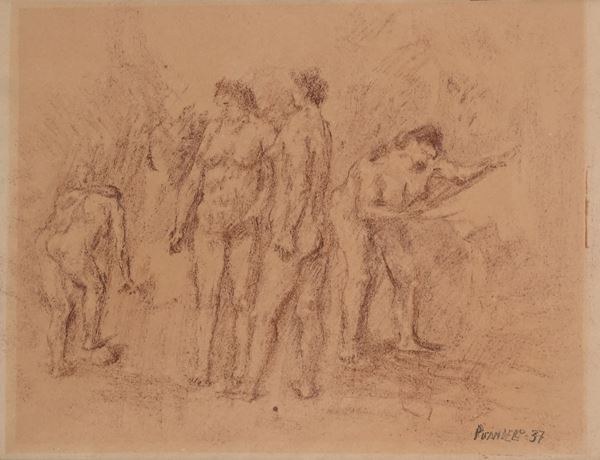
Bagnanti
Firma e data "Pirandello 37" Sanguigna su carta cm 21x27 - in cornice cm 45x51
Sold
Fausto Pirandello©
(Roma, 1899 - Roma, 1975)
Bagnanti
Firma e data in basso a sinistra "Pirandello '54" Pastelli su carta cm 22x27 - in cornice cm 42x48
Sold
Fausto Pirandello©
(Roma, 1899 - Roma, 1975)
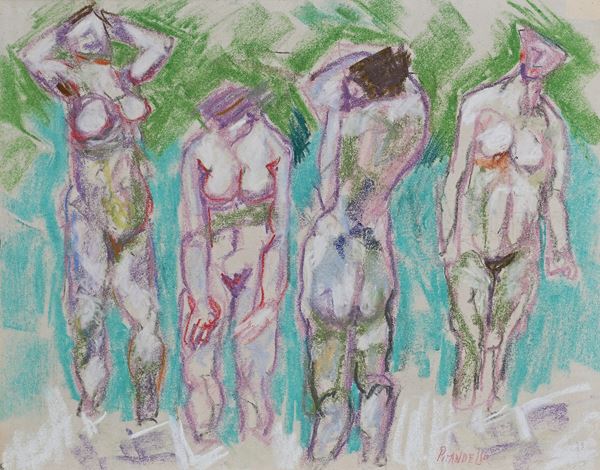
Bagnanti
Firmato in basso a destra "Pirandello" Pastelli su carta cm 22x28 - con cornice cm 37,5x48
Sold
Bagnanti
Firma in basso a sinistra "Pirandello". Al verso etichetta della Galleria La Vetrata, Roma Pastelli su carta cm 28x22 - [..]
Sold
Fausto Pirandello©
(Roma, 1899 - Roma, 1975)
Bagnanti
Firma in basso a destra "Pirandello". Al verso reca firma non decifrata "C. F...Pirandello" Pastelli cerosi su carta cm [..]
Sold
Fausto Pirandello©
(Roma, 1899 - Roma, 1975)
I Bagnanti
I Bagnanti
Pastello su carta, cm 22x28
Firmato "Pirandello" in basso al centro, datato 16-V-71 in basso a destra
Etichetta [..]
Sold
Bathers
Signed "Pirandello" on the lower right front.
Sold
Nudo di donna
Firma e data "Pirandello '43" Acquaforte cm 28x36
Sold
Bagnanti
Firma e numerazione sul fronte in basso "Pirandello 175/200".
Sold
Fausto Pirandello©
(Roma, 1899 - Roma, 1975)
Bagnanti
Firma, data e numerazione "Pirandello, 1966, 6/50" Litografia cm 70x50 - in cornice cm 74x54
Sold
Fausto Pirandello©
(Roma, 1899 - Roma, 1975)
Bagnanti
Firma e numerazione "Pirandello 292/300" Litografia cm 41x62 - in cornice cm 57,5x78
Fausto Pirandello©
(Roma, 1899 - Roma, 1975)
Figure
Firma in basso a destra "Pirandello" Pastelli su carta cm 26x21 - in cornice cm 44x39
Paesaggio
Firma e data in basso a sinistra "Pirandello '33"
Fausto Pirandello©
(Roma, 1899 - Roma, 1975)
Bagnanti
Firma e numerazione sul fronte "Pirandello 49/99". sc.
Fausto Pirandello©
(Roma, 1899 - Roma, 1975)
BAGNANTI
BAGNANTI - Litografia, cm 50x70.Firma e numerazione sul fronte "Pirandello, 28/90".
Fausto Pirandello©
(Roma, 1899 - Roma, 1975)
BAGNANTI
BAGNANTI - Litografia, cm 50x60. Firma e numerazione sul fronte "Pirandello, 28/90".