
47
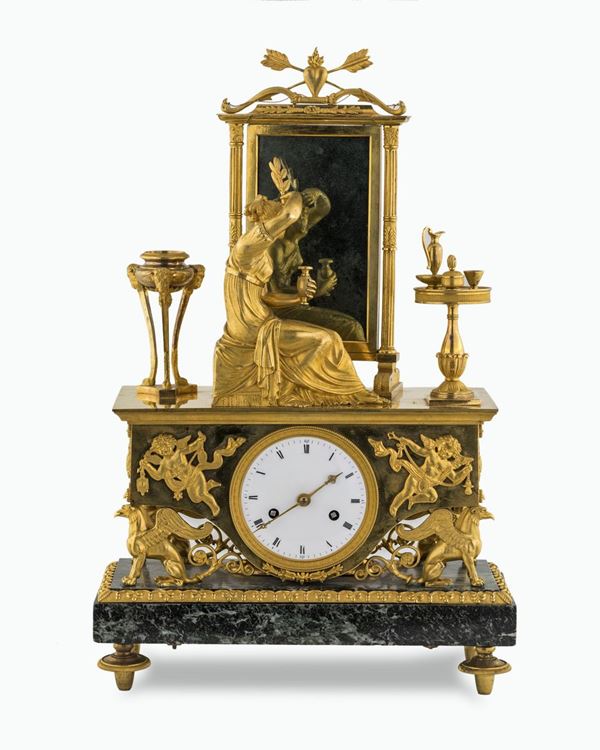
Gilt bronze and green marble clock, France, Empire period
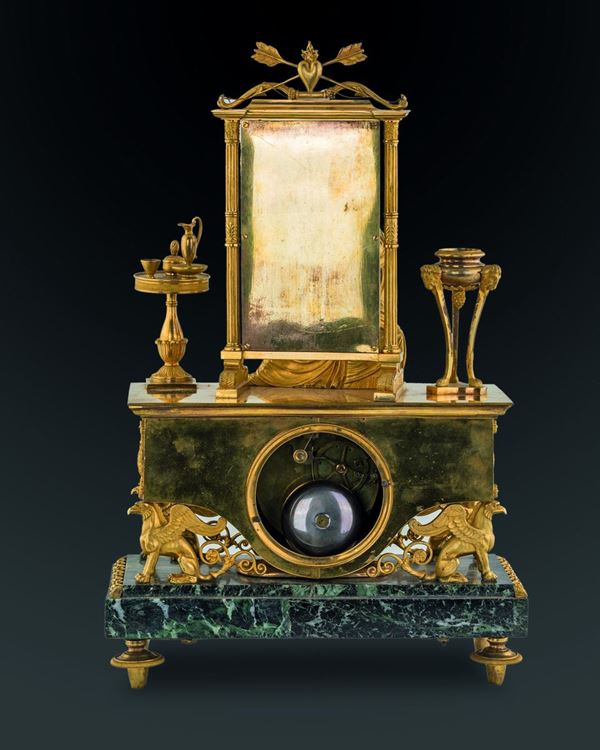
characterized by a genre scene according to the fashion of the early nineteenth century in France, played by a young woman in classic clothes in the act of adorning herself in front of a mirror flanked by an athénienne adorned with bucrania and a round banister table with some furnishings. Perhaps the composition is inspired by the so-called "Toilet of Psyche", a particular iconography linked to the myth of Cupid and Psyche that was developed late and autonomously compared to the novel by Apuleius, where the beauty treatments to which Psyche is subjected before the meeting with her lover are briefly mentioned. The starting iconography seems to be a Pompeian fresco in the house of Marco Lucretius Frontone, which depicts the Toilet of Venus. This subject that interested Raphael at the time of the paintings in the Loggia of Cupid and Psyche at the Farnesina and of which remains testimony, in the adaptation to the figure of Psyche, in a print by Giulio Bonasone (1560 ca., London, British Museum), had later some luck and became a typical subject. For example, Boucher also used it for the subject of a tapestry made in the decade 1740, during his stay in Rome (today at the Quirinal Palace). On our watch the figure of a young girl has no iconographic connection with the dressing table of Venus or Psyche, episodes made up of several characters; however the presence of a coping above the mirror made up of a heart pierced by two arrows that form a curious panoply with a bow placed horizontally, reminds us of a typical emblem of Cupid. Nor should it be forgotten that this typical neoclassical mirror is called "psyche". The large base of the clock is adorned with gilt bronze applications depicting cupids as if to reaffirm the sensual character of the scene. The clock is supported on a green marble base by four feet in the shape of griffins, fantastic animals sacred to Apollo and guardians of his treasures. Movement with anchor escapement, striking of the hour and half as it passes.
See for comparison: Giacomo Wannenes, The most beautiful French clocks from Louis XIV to the Empire, Leonardo editore Milano 1991, p. 169
cm 53x34x14,5
€ 5.000,00 / 7.000,00
Estimate