
80
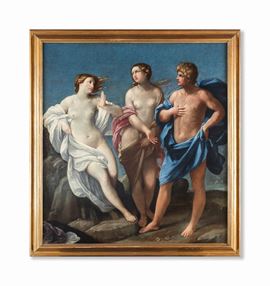
Bacchus and Ariadne
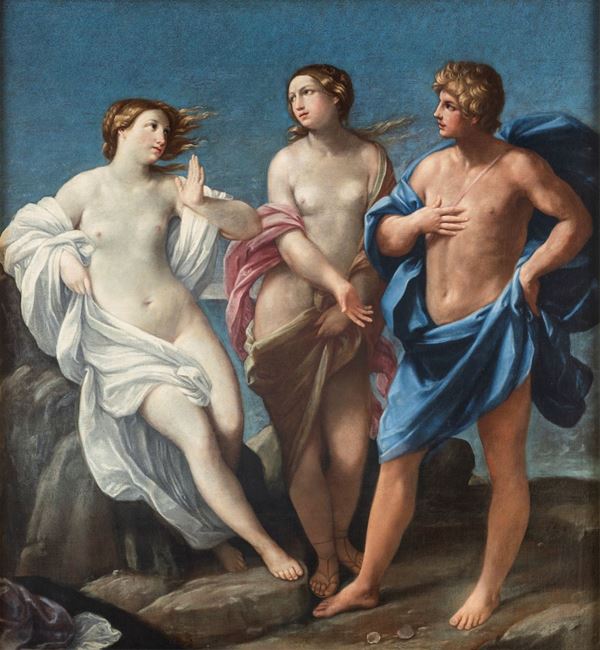
Wedding of Bacchus and Ariadne in 1640 for the French queen Henrietta Maria, who ordered it in 1637 as the ceiling of her bedroom in the Queen's House in Greenwich. The negotiation, with strong diplomatic values, was followed by Cardinal Francesco Barberini himself. Finally, as is sadly known, the work was subsequently dismembered, and only recently has the original fragment with Arianna reappeared (Pinacoteca di Bologna).
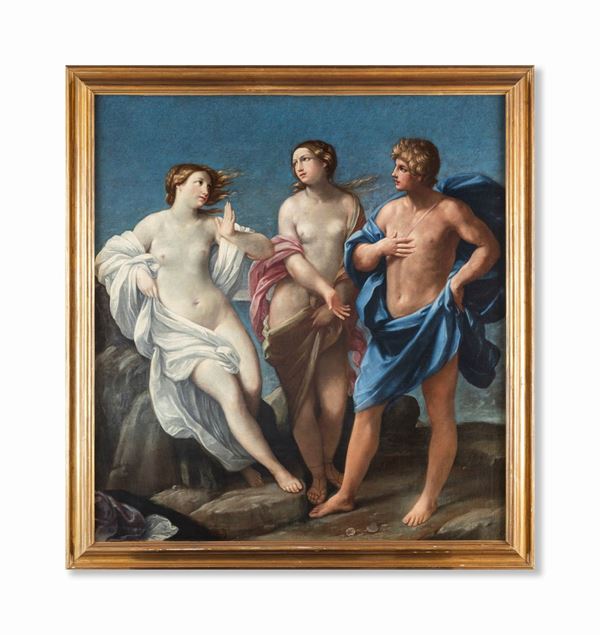
The proposed painting, most likely executed in Bologna before the departure of the work destined for England, as has been hypothesized for the version now in storage at the Accademia di San Luca in Rome, must have been made inside the workshop of the master.
The pictorial quality is in fact at times extremely high, as in the figure of Arianna, so much so that the exclusion of Reni's intervention must be considered a stretch. The drapery and the complexion of the latter are congruent, to an analysis of the brushstroke, with those of the Fortuna of the Vatican Pinacoteca and with other paintings of the last period of Reni (the photograph on p.37 of the volume published by Edizioni de Luke shows how the drapery was heavily covered with white pigment, and therefore cannot be used as a comparison). Conversely, in the figure of Bacchus a different, more insecure hand is recognizable, certainly that of a collaborator.
This version differs in terms of quality from the one kept in Palazzo Montecitorio, given to an unknown painter at the beginning of the 18th century, and it can be excluded that it could be the copy made by Romanelli or the one made by Paolo Gismondi, which had to represent the scene in its entirety. .
The fact that the section of the scene depicted brings variations with respect to the other versions known to us (the three figures have different spatial relationships), seems to confirm the genuineness of the painting, as well as that it can be excluded that it may be a fragment deriving from a replica bigger. The client must have explicitly requested the master to create a work that had its own character of originality, a practice that led Guido Reni to modify more or less significant parts of famous compositions (think of the versions of Fortuna, of which we know at least three originals).
Bibliography: S. Pepper, Guido Reni: the complete work, IGDA 1988; M. Pirondini - E. Negro (edited by), The school of Guido Reni, Modena 1992, pp.17-25; Guido Reni: the wedding of Bacchus and Ariadne, Edizioni de Luca 2000
cm 166x152