Evaluation Maurice de Vlaminck
Maurice de Vlaminck Valuations - Want to sell a Maurice de Vlaminck piece? Request a complimentary and confidential valuation!Casa d'Aste Arcadia will review your submission and offer a free-of-charge estimate, if your item is suitable for our auctions.
biography
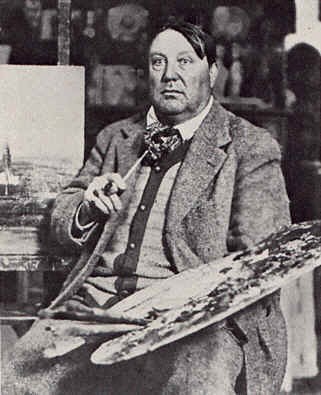
Maurice de Vlaminck (Paris, 1876 – Rueil-la-Gadelière, 1958) was a French painter and one of the principal exponents of Fauvism, the avant-garde movement that revolutionized European art in the early twentieth century. Born to musician parents, Vlaminck initially dedicated himself to the study of violin, but after meeting André Derain in Chatou, his interest turned decisively toward painting. Self-taught, he developed a style characterized by great immediacy and expressive freedom, rejecting philosophical or literary interpretations of art. His artistic formation was profoundly influenced by the observation of works by Vincent van Gogh and Henri Matisse, from whom he drew inspiration for the use of pure and vibrant colors. In 1905, Vlaminck participated in the celebrated Salon d'Automne in Paris, where the Fauves group exhibited for the first time, causing great scandal in critical circles. Critics recognized him as the most radical exponent of the movement, thanks to his aggressive style and use of pure colors, sometimes squeezed directly from the tube onto the canvas. He expressed his strong personality through preferred themes such as portraits, landscapes, and urban peripheries, characterized by exasperated and contrasting chromatic ranges. After 1907, the fragile union of the Fauves dissolved and Vlaminck pursued an autonomous path. Influenced by the work of Paul Cézanne, his painting gradually transformed, abandoning the bright tones of Fauvism to arrive at landscapes and still lifes with more muted colors and dramatically expressive chromaticism. He went through a brief phase of Cubist inspiration around 1910, before being recalled for the First World War. In the postwar period, his art oriented itself toward realistic and expressionist figuration, representing countryside landscapes in darker tones and with strong impasto. Vlaminck was a restless and rebellious artist who considered painting as a form of struggle and disobedience against old conventions. He wrote numerous polemical texts, including Tournant dangereux (1929), Portraits avant décès (1943), and Paysages et personnages (1950). During the Second World War, Vlaminck accepted a trip to Germany sponsored by Goebbels together with seven other French artists, a fact that led him to be arrested in 1944 for collaboration with the Nazis and subsequently marginalized after the war. He died on October 11, 1958, in Rueil-la-Gadelière, leaving a significant artistic legacy in the panorama of modern European art.
Past lots of Maurice de Vlaminck
Maurice de Vlaminck
(Parigi, 1876 - Rueil-la-Gadelière, 1958)
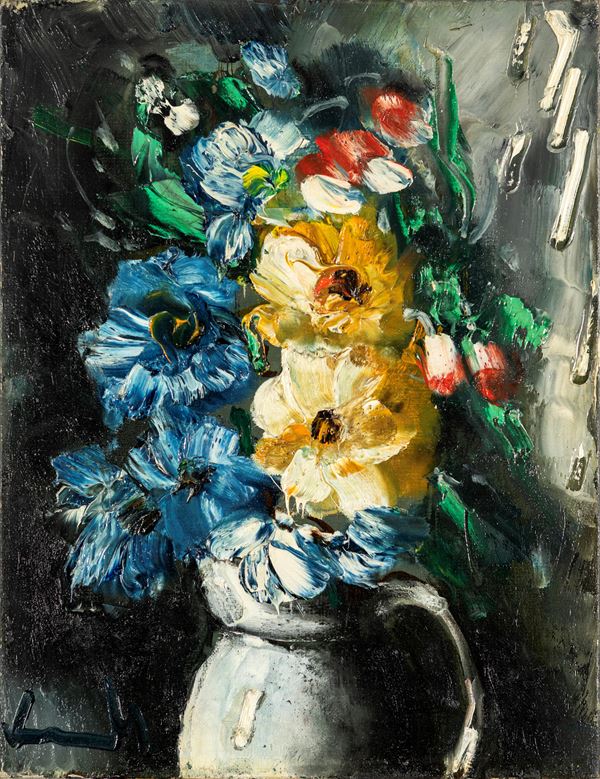
Bouquet de fleurs au pichet blanc
signed lower left Vlaminck On the back, on the stretcher, a printed label from Galerie Charpentier, 76 Faubourg Saint-Honoré [..]
Sold
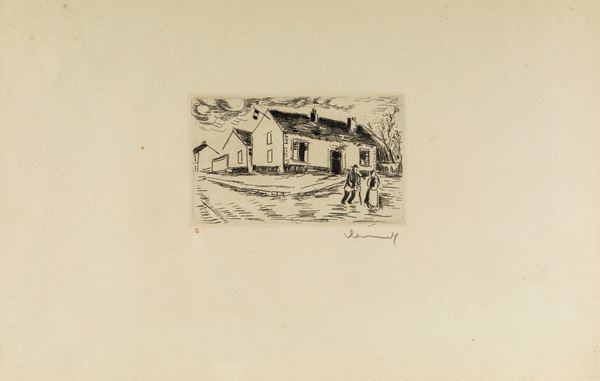
Paesaggio
Firma in basso a destra. Monogramma in basso a sinistra a inchiostro rosso non decifrato. Timbri a secco della "Libreria [..]