Evaluation Marc Chagall
Marc Chagall Valuations - Want to sell a Marc Chagall piece? Request a complimentary and confidential valuation!Casa d'Aste Arcadia will review your submission and offer a free-of-charge estimate, if your item is suitable for our auctions.
biography
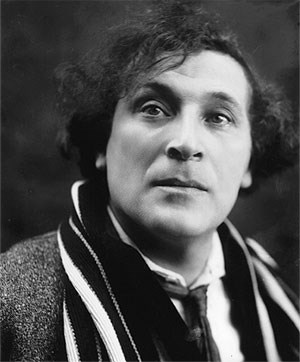
Marc Chagall, whose Hebrew name was Moishe Segal and whose Russian name was Mark Zacharovic Šagal, was born on July 7, 1887, in Lëzna, near Vitebsk, in Belarus, then part of the Russian Empire. Coming from a Hasidic Jewish family of humble origins, Chagall grew up in an environment rich in religious tradition and Yiddish culture. In 1900 he began working as a retoucher before fully dedicating himself to painting, studying at Yehuda Pen's workshop school in Vitebsk and subsequently attending the Russian Academy of Fine Arts in Saint Petersburg, where he encountered important artists and discovered Western art by Cézanne and Matisse.
In 1910 Chagall moved to Paris, where he remained until 1914, entering the artistic environment of Montparnasse and becoming a representative exponent of the École de Paris. His works from this period were characterized by memories of Russian rural life and Jewish tradition, rich in symbolic and fantastical elements. After returning to Russia in 1914, he actively participated in the 1917 Revolution and was appointed commissioner of fine arts in Vitebsk, where he founded an Academy. In 1920 he moved to Moscow, then to Berlin in 1922, and finally returned to Paris in 1923, where he collaborated with gallerist Ambroise Vollard, creating engravings for Gogol's Dead Souls and La Fontaine's Fables.
During World War II, due to racial laws and Nazi persecution, Chagall and his family hid in Marseille at Villa Air-Bel, receiving help from American journalist Varian Fry to escape to Spain and Portugal. In June 1941 he emigrated to the United States, where he remained until 1948, maintaining intense artistic activity and meeting numerous European artists fleeing Europe. Returning to France, he participated in the XXV Biennale, receiving the engraving prize for biblical works, and in 1950 moved to Vence, where the Message Biblique Museum was inaugurated in Nice in 1973, dedicated to his works with biblical and evangelical themes.
Chagall maintained a strong presence in the international artistic landscape until his death on March 28, 1985, in Saint-Paul-de-Vence, at the age of 97. Buried in the local cemetery, he is remembered as one of the greatest painters of the twentieth century, a bold colorist and narrator suspended between the real and the fabulous. His works, characterized by a repertoire of images that fuses human figures, animals, objects, and landscapes with biblical motifs, are found in major institutions such as the Marc Chagall National Museum in Nice, MoMA in New York, the Centre Pompidou in Paris, and the Tate in London, testifying to his fundamental contribution to European artistic movements of the twentieth century.
In 1910 Chagall moved to Paris, where he remained until 1914, entering the artistic environment of Montparnasse and becoming a representative exponent of the École de Paris. His works from this period were characterized by memories of Russian rural life and Jewish tradition, rich in symbolic and fantastical elements. After returning to Russia in 1914, he actively participated in the 1917 Revolution and was appointed commissioner of fine arts in Vitebsk, where he founded an Academy. In 1920 he moved to Moscow, then to Berlin in 1922, and finally returned to Paris in 1923, where he collaborated with gallerist Ambroise Vollard, creating engravings for Gogol's Dead Souls and La Fontaine's Fables.
During World War II, due to racial laws and Nazi persecution, Chagall and his family hid in Marseille at Villa Air-Bel, receiving help from American journalist Varian Fry to escape to Spain and Portugal. In June 1941 he emigrated to the United States, where he remained until 1948, maintaining intense artistic activity and meeting numerous European artists fleeing Europe. Returning to France, he participated in the XXV Biennale, receiving the engraving prize for biblical works, and in 1950 moved to Vence, where the Message Biblique Museum was inaugurated in Nice in 1973, dedicated to his works with biblical and evangelical themes.
Chagall maintained a strong presence in the international artistic landscape until his death on March 28, 1985, in Saint-Paul-de-Vence, at the age of 97. Buried in the local cemetery, he is remembered as one of the greatest painters of the twentieth century, a bold colorist and narrator suspended between the real and the fabulous. His works, characterized by a repertoire of images that fuses human figures, animals, objects, and landscapes with biblical motifs, are found in major institutions such as the Marc Chagall National Museum in Nice, MoMA in New York, the Centre Pompidou in Paris, and the Tate in London, testifying to his fundamental contribution to European artistic movements of the twentieth century.
Past lots of Marc Chagall
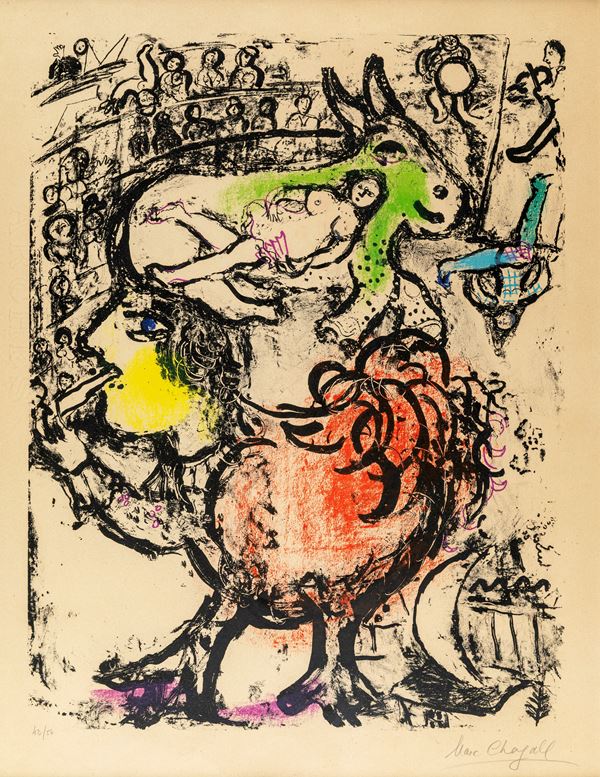

Marc Chagall
(Lezna, 1887 - San Paolo di Venza, 1985)
Pirouette au cirque
Firma e numerazione a matita "Marc Chagall, 52/50". Timbro a secco Libreria Prandi Reggio Emilia Litografia a colori cm [..]
Sold
Marc Chagall
(Lezna, 1887 - San Paolo di Venza, 1985)
La Fenêtre de l'Atelier à Saint-Paul
Firma e numerazione "Marc Chagall 14/50" Acquaforte cm 17x15 (lastra) - in cornice cm 43x33
Sold
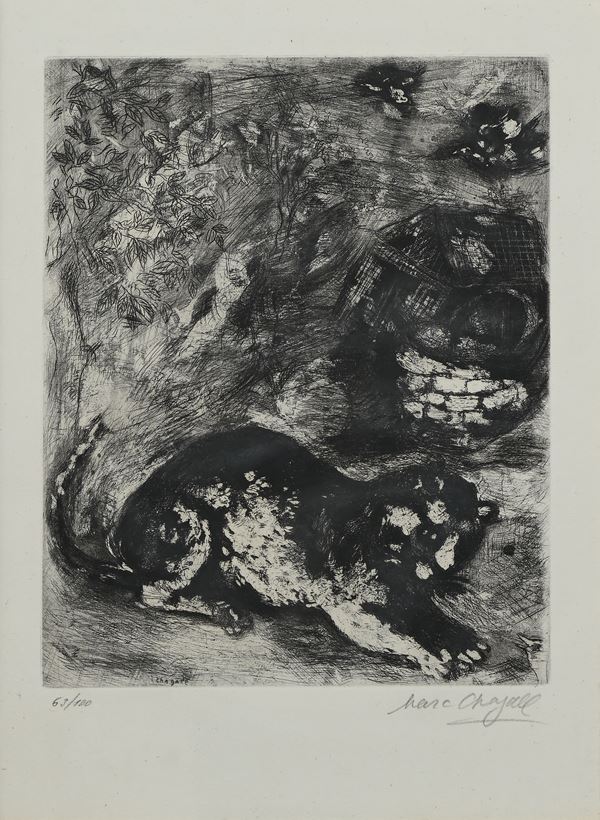
Marc Chagall
(Lezna, 1887 - San Paolo di Venza, 1985)
Le Chat et les deux Moineaux
Firma e numerazione sul fronte "Marc Chagall 63/100". Firma in lastra "Chagall". Al verso reca timbro della 1° Biennale [..]
Sold
Marc Chagall
(Lezna, 1887 - San Paolo di Venza, 1985)
La nuit des amoureux a Saint-Paul
Firma e numerazione "Marc Chagall 17/50". Timbro a secco dello stampatore in basso a destra Incisione cm 48x37 - in cornice [..]
Sold
Marc Chagall
(Lezna, 1887 - San Paolo di Venza, 1985)
L'homme et idole de bois
Signature and numbering on the lower front "Marc Chagall, 86/100".
Sold
Marc Chagall
(Lezna, 1887 - San Paolo di Venza, 1985)
Senza titolo (Il pappagallo)
Firma su lastra "Chagall". Numerazione a matita in basso a sinistra 18/85
Sold
Marc Chagall
(Lezna, 1887 - San Paolo di Venza, 1985)
No title
Signature and numbering "Marc Chagall, H.c." - etching Acquaforte/acquatinta cm 60x43
Marc Chagall
(Lezna, 1887 - San Paolo di Venza, 1985)
Autoritratto
Marc Chagall
(Lezna, 1887 - San Paolo di Venza, 1985)
Les amants au bouquet
Marc Chagall
(Lezna, 1887 - San Paolo di Venza, 1985)
Les amoreux au soleil rouge
Marc Chagall
(Lezna, 1887 - San Paolo di Venza, 1985)
L'ange
Marc Chagall
(Lezna, 1887 - San Paolo di Venza, 1985)
La Jongleuse
Marc Chagall
(Lezna, 1887 - San Paolo di Venza, 1985)