

Evaluation Lippo d'Andrea, detto Pseudo-Ambrogio di Baldese
Lippo d'Andrea, detto Pseudo-Ambrogio di Baldese Valuations - Want to sell a Lippo d'Andrea, detto Pseudo-Ambrogio di Baldese piece? Request a complimentary and confidential valuation!Casa d'Aste Arcadia will review your submission and offer a free-of-charge estimate, if your item is suitable for our auctions.
biography
Lippo d'Andrea, also known as Pseudo-Ambrogio di Baldese, was an Italian painter active mainly in Florence from the late 14th century to the first half of the 15th century. Born around 1370-1371, his artistic career spans a transitional period between the late Gothic and early Renaissance in Florence. In 1411, he joined the Compagnia di San Luca, a prominent artists' guild, and that same year he was commissioned to paint frescoes on the facade of the Palazzo del Ceppo in Prato, collaborating with painters such as Niccolò di Pietro Gerini and Ambrogio di Baldese.
His works were long attributed under the name Pseudo-Ambrogio di Baldese until modern scholarship identified this figure as Lippo d'Andrea. Among his notable works are frescoes in the Nerli Chapel of Santa Maria del Carmine in Florence, attributed to him based on records mentioning an artist named Lippo active in 1402. In 1435-36, he took part in a significant project to paint frescoes of the apostles in the tribune chapels of Florence Cathedral, celebrating the consecration of the dome by Pope Eugene IV.
Although considered a minor master compared to contemporaries like Lorenzo Monaco or Fra Angelico, Lippo d'Andrea achieved reasonable commercial success, as evidenced by the number and prestige of his surviving works. Around 1442, he stopped painting and in 1447 declared he could no longer support himself through his craft. He died before 1451. His oeuvre represents one of the more conservative trends in early 15th-century Florentine painting but remains an important witness to the artistic culture of that era.
His works were long attributed under the name Pseudo-Ambrogio di Baldese until modern scholarship identified this figure as Lippo d'Andrea. Among his notable works are frescoes in the Nerli Chapel of Santa Maria del Carmine in Florence, attributed to him based on records mentioning an artist named Lippo active in 1402. In 1435-36, he took part in a significant project to paint frescoes of the apostles in the tribune chapels of Florence Cathedral, celebrating the consecration of the dome by Pope Eugene IV.
Although considered a minor master compared to contemporaries like Lorenzo Monaco or Fra Angelico, Lippo d'Andrea achieved reasonable commercial success, as evidenced by the number and prestige of his surviving works. Around 1442, he stopped painting and in 1447 declared he could no longer support himself through his craft. He died before 1451. His oeuvre represents one of the more conservative trends in early 15th-century Florentine painting but remains an important witness to the artistic culture of that era.
Past lots of Lippo d'Andrea, detto Pseudo-Ambrogio di Baldese
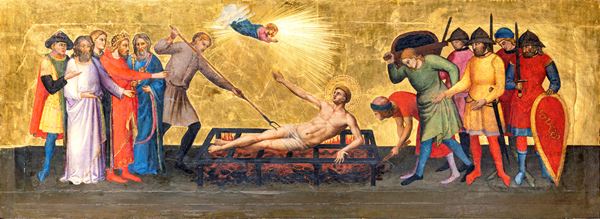
Lippo d'Andrea, detto Pseudo-Ambrogio di Baldese
Sphere of
Martirio di San Lorenzo
Scomparto di predella tempera e oro su tavola cm 24,5x65,5 - con cornice cm 36,5x78,5
Sold