
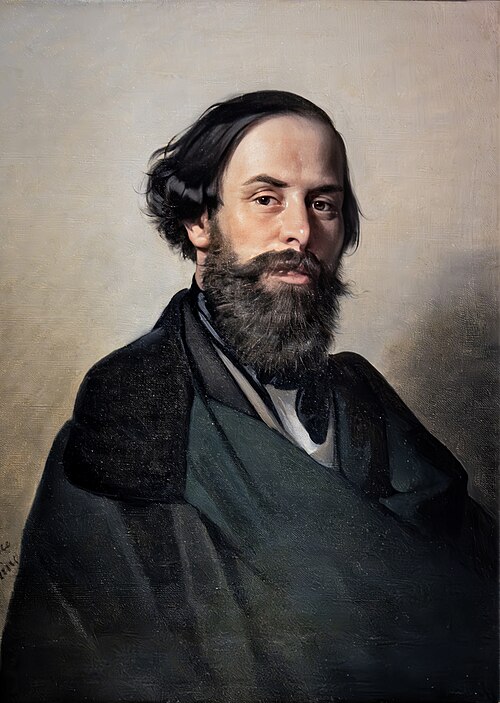
Evaluation Ippolito Caffi
Ippolito Caffi Valuations - Want to sell a Ippolito Caffi piece? Request a complimentary and confidential valuation!Casa d'Aste Arcadia will review your submission and offer a free-of-charge estimate, if your item is suitable for our auctions.
biography
Ippolito Caffi, born in Belluno on October 16, 1809, and died in Lissa on July 20, 1866, was a renowned Italian painter specializing in architectural views, seascapes, and urban vedute. Born to Giacomo Caffi and Maria Castellani, he began his artistic training in 1821 in Belluno with Antonio Federici and Antonio Tessari. As a young man, he moved to Padua to join his cousin Pietro Paoletti, a figure painter working in Giovanni Demin's workshop. He later studied at the Venice Academy, where he engaged with the tradition of 18th-century Venetian vedutisti, as seen in his famous 'Rialto Bridge' housed at Ca' Pesaro. In 1832, he relocated to Rome with his cousin, opening his own studio in 1833 dedicated to plein-air painting and drawing, creating theater scenes in Rome and spending time in Naples.
Ippolito Caffi's life was marked by extensive travels and strong patriotic commitment. After a stay in Milan, he joined the Venetian revolutionary movements of 1848, was imprisoned but escaped to return to Venice, where he married Virginia Missana. In 1850, he settled in Turin, exhibiting six paintings at the London Universal Exposition. In 1854, he visited Spain and Paris, residing there temporarily and participating in the 1855 Universal Exposition. After 1860, with Italian Unification, he returned to Venice to resume painting. His works, characterized by a realistic and luminous style, masterfully capture ports, cities, and landscapes, such as 'The Port of Genoa', establishing him as one of the foremost exponents of 19th-century Italian vedutismo.
Ippolito Caffi met a tragic end during the Third War of Independence, boarding the ship 'Re d'Italia' to commemorate Italy's first naval engagement. The vessel was sunk by the Austro-Hungarian fleet in the Battle of Lissa on July 20, 1866, leading to his drowning at age 57. Ippolito Caffi's artworks are highly sought after in the art market today, with auctions like those at Arcadia valuing the master's paintings and vedute, affirming his pivotal role in pictorial realism and Venetian vedutismo.
Ippolito Caffi's life was marked by extensive travels and strong patriotic commitment. After a stay in Milan, he joined the Venetian revolutionary movements of 1848, was imprisoned but escaped to return to Venice, where he married Virginia Missana. In 1850, he settled in Turin, exhibiting six paintings at the London Universal Exposition. In 1854, he visited Spain and Paris, residing there temporarily and participating in the 1855 Universal Exposition. After 1860, with Italian Unification, he returned to Venice to resume painting. His works, characterized by a realistic and luminous style, masterfully capture ports, cities, and landscapes, such as 'The Port of Genoa', establishing him as one of the foremost exponents of 19th-century Italian vedutismo.
Ippolito Caffi met a tragic end during the Third War of Independence, boarding the ship 'Re d'Italia' to commemorate Italy's first naval engagement. The vessel was sunk by the Austro-Hungarian fleet in the Battle of Lissa on July 20, 1866, leading to his drowning at age 57. Ippolito Caffi's artworks are highly sought after in the art market today, with auctions like those at Arcadia valuing the master's paintings and vedute, affirming his pivotal role in pictorial realism and Venetian vedutismo.
Past lots of Ippolito Caffi

Ippolito Caffi
(Belluno, 1809 - Lissa, 1866)
Volo sul pallone
firmato in basso a sinistra Caffi Sul retro vecchia scritta Raccolta P. Dini gouache su cartoncino riportato su cartone [..]
Sold
Ippolito Caffi
(Belluno, 1809 - Lissa, 1866)
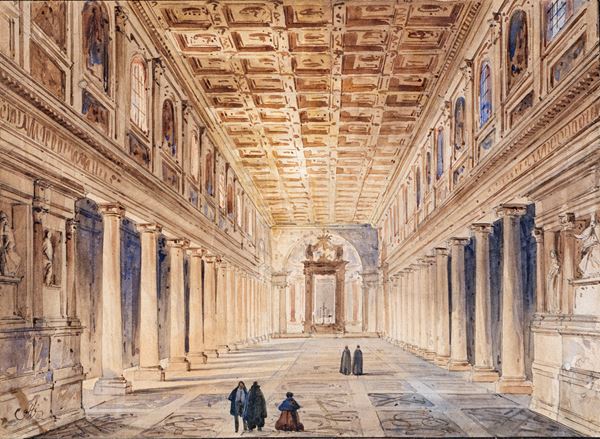
Veduta dell'interno della Basilica di Santa Maria Maggiore
Firma in basso a sinistra: "Caffi". acquerelli su carta cm 20x27 - in cornice: 37x48
Sold
Ippolito Caffi
(Belluno, 1809 - Lissa, 1866)
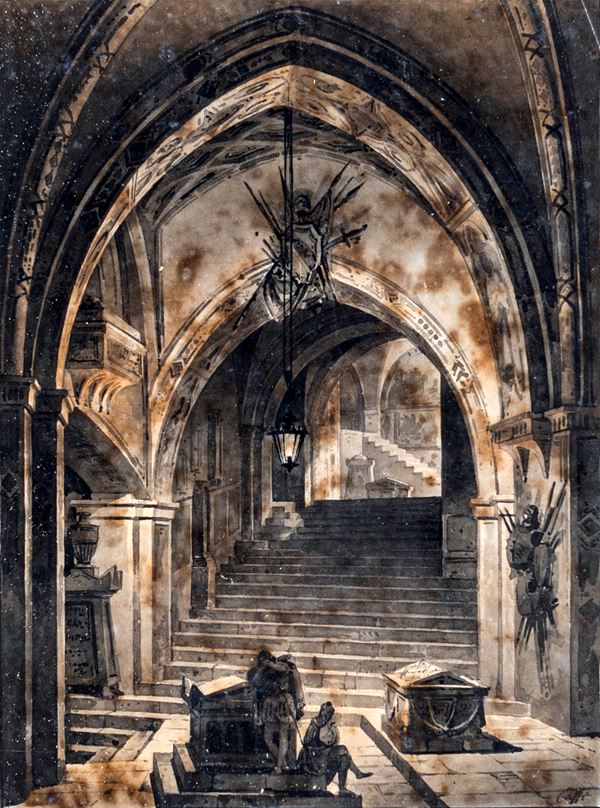
Interno con figure
Firamato in basso a destra Caffi. Macchie di umidità Acquarello su carta Cm 26 x 20 con cornice cm 52 x 43