
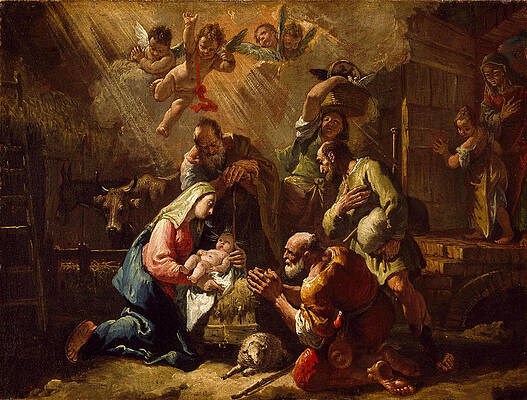
Evaluation Francesco Fontebasso
Francesco Fontebasso Valuations - Want to sell a Francesco Fontebasso piece? Request a complimentary and confidential valuation!Casa d'Aste Arcadia will review your submission and offer a free-of-charge estimate, if your item is suitable for our auctions.
biography
Francesco Salvatore Fontebasso was born in Venice on October 4, 1707, and died in the same city on May 31, 1769. He was one of the principal exponents of Venetian painting during the Rococo period and one of the protagonists of the extraordinary artistic season of eighteenth-century Venice. Trained in the workshop of master Sebastiano Ricci, in 1728 he traveled to Rome where he won third prize in the first class of painting at the Academy of S. Luca with the drawings The Feast of Belshazzar and Adam and Eve, which represent his first known works. Returning to Venice, his painting was profoundly influenced by that of Giambattista Tiepolo, as evidenced by works such as the Marriage of Saint Catherine and the Adoration of the Shepherds. By the fourth decade of the eighteenth century, Fontebasso had fully defined his personal pictorial language, successfully blending Ricci's teaching, evident in clear and vibrant colors, with the Roman-Bolognese lesson aimed at dense plasticism of bodies and solid architectural-perspective structure. The happiest moment of Fontebasso's career coincided with grand decoration around the middle of the century, when he became one of the most sought-after painters by Venetian nobility, also thanks to Tiepolo's absence or unavailability. His decorative gifts, evidenced by his mastery of foreshortening and the intensity and vivacity of colors in his frescoes, made him a protagonist of the great season of Venetian Rococo. He executed numerous decorated interiors in Venice, including Ca' Duodo where, around 1743, he created canvases and frescoes for the ceilings. He also worked on the villa Ca' Zenobio near Treviso, where he frescoed the allegories of Justice, Peace, and Virtues in the first-floor hall within refined rocaille stuccos. He also worked in Padua, Treviso, and Trento, creating frescoes and altarpieces of notable quality. In 1761 Francesco was called to Saint Petersburg by Empress Elizabeth to decorate the ceiling of the Winter Palace church, where he remained until 1762 creating canvases and frescoes. With the journey to Russia, the artistically happiest period of the artist's activity came to a close. Upon his return, official recognition consecrated him among the leaders of the Venetian school: in 1768 he was elected President of the Academy. Fontebasso established himself as one of the greatest masters of eighteenth-century Venetian painting, a highly sought-after painter of large historical paintings and mural decorations, leaving a significant artistic legacy in the history of Venetian painting.
Past lots of Francesco Fontebasso
![Francesco Fontebasso (workshop of) (Venice 1707 - Venice 1769) a) Sophonisba; b) Clemency of Scipione [..]](https://api.astearcadia.com/api/lotto/immagine/40935/0/600.jpg)
Francesco Fontebasso
(Venezia, 1707 - Venezia, 1769)
Workshop of
Francesco Fontebasso (workshop of) (Venice 1707 - Venice 1769) a) Sophonisba; b) Clemency of Scipione [..]
A pupil of Sebastiano Ricci, Francesco Fontebasso deeply absorbed the influence of Giambattista Tiepolo, establishing himself [..]
Sold
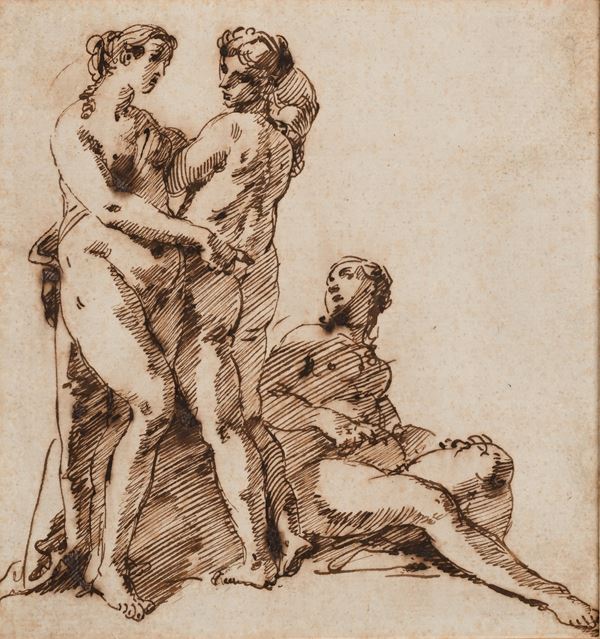
Francesco Fontebasso
(Venezia, 1707 - Venezia, 1769)
Studio per le Ninfe al bagno
Il bel foglio mostra strette affinità stilistiche con il disegno conservato all’Art Museum dell’Università [..]