
Evaluation Eugène-Louis Boudin
Eugène-Louis Boudin Valuations - Want to sell a Eugène-Louis Boudin piece? Request a complimentary and confidential valuation!Casa d'Aste Arcadia will review your submission and offer a free-of-charge estimate, if your item is suitable for our auctions.
biography
Eugène-Louis Boudin, born on July 12, 1824, in Honfleur, Normandy, was one of the most significant French painters of the 19th century, renowned especially for his seascapes and coastal landscapes. The son of a modest family deeply connected to the sea—his father was a harbor pilot and later a captain, his mother a stewardess—Boudin spent his childhood between Honfleur and Le Havre, where the family moved in 1835[1][3]. As a child, he worked as a cabin boy on his father’s boat, the Polichinelle, an experience that profoundly shaped his artistic sensibility and his lifelong passion for the sea[3][4].
In Le Havre, Boudin began as an apprentice in a printing house and later in a stationery shop, where he met local artists and became acquainted with the art world[1][3]. It was during this period that he encountered painters such as Jean-François Millet, Thomas Couture, and Constant Troyon, who encouraged him to pursue painting[2][5]. At the age of 22, he left the shop to devote himself entirely to art, beginning to paint en plein air, directly from nature, thus anticipating the technique that would define Impressionism[6].
In 1850, he received a scholarship that allowed him to move to Paris, where he studied with Eugène Isabey and worked as a copyist at the Louvre, further refining his technical skills[1][5]. However, the heart of his work always remained the Norman coast, with its changing skies, bustling beaches, and lively harbors. Boudin became famous for his ability to capture light, atmosphere, and reflections on water, so much so that Jean-Baptiste Corot nicknamed him the “king of the skies”[1][6].
His influence on the Impressionists was considerable: it was he who introduced the young Claude Monet to plein air painting, often working alongside him in the 1860s[7]. Boudin participated in several exhibitions, including the Paris Salon, and his works were appreciated by both critics and the public. He died on August 8, 1898, in Deauville, leaving a fundamental artistic legacy for the development of modern landscape painting. Today, his works are held in major international museums and are highly sought after at art auctions, such as those organized by Arcadia.
In Le Havre, Boudin began as an apprentice in a printing house and later in a stationery shop, where he met local artists and became acquainted with the art world[1][3]. It was during this period that he encountered painters such as Jean-François Millet, Thomas Couture, and Constant Troyon, who encouraged him to pursue painting[2][5]. At the age of 22, he left the shop to devote himself entirely to art, beginning to paint en plein air, directly from nature, thus anticipating the technique that would define Impressionism[6].
In 1850, he received a scholarship that allowed him to move to Paris, where he studied with Eugène Isabey and worked as a copyist at the Louvre, further refining his technical skills[1][5]. However, the heart of his work always remained the Norman coast, with its changing skies, bustling beaches, and lively harbors. Boudin became famous for his ability to capture light, atmosphere, and reflections on water, so much so that Jean-Baptiste Corot nicknamed him the “king of the skies”[1][6].
His influence on the Impressionists was considerable: it was he who introduced the young Claude Monet to plein air painting, often working alongside him in the 1860s[7]. Boudin participated in several exhibitions, including the Paris Salon, and his works were appreciated by both critics and the public. He died on August 8, 1898, in Deauville, leaving a fundamental artistic legacy for the development of modern landscape painting. Today, his works are held in major international museums and are highly sought after at art auctions, such as those organized by Arcadia.
Past lots of Eugène-Louis Boudin
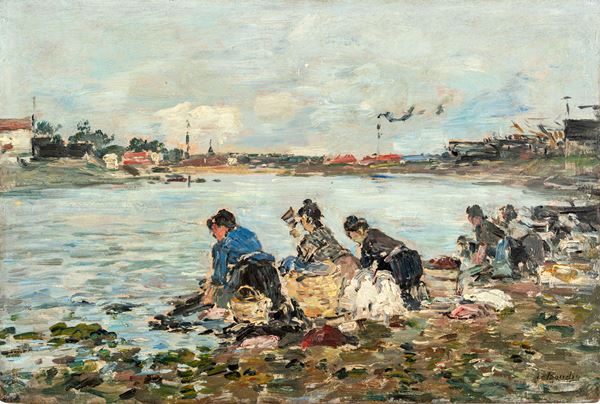
Eugène-Louis Boudin
(Honfleur, 1824 - Deauville, 1898)
Laveuses au bord de la Touques
Signed lower right E. Boudin Old reference numbers on the back. Eugène Boudin is considered one of the precursors [..]
Sold