Evaluation Eberhard o Bernhard Keilhau, detto Monsù Bernardo
Eberhard o Bernhard Keilhau, detto Monsù Bernardo Valuations - Want to sell a Eberhard o Bernhard Keilhau, detto Monsù Bernardo piece? Request a complimentary and confidential valuation!Casa d'Aste Arcadia will review your submission and offer a free-of-charge estimate, if your item is suitable for our auctions.
biography
Eberhard or Bernhard Keilhau, known in Italy by the pseudonym Monsù Bernardo, was a Danish painter of extraordinary importance in the artistic panorama of the seventeenth century. Born in Helsingør in 1624, he began his artistic training under the guidance of his father Gaspard and the Danish master Morten van Steenwinkel, in whose workshop he was placed at the age of twelve. His career reached a crucial moment when, at eighteen years old, he moved to the Netherlands and entered the celebrated workshop of Rembrandt in Amsterdam, where he remained between 1642 and 1644, absorbing the techniques and influence of the great Dutch master. This formative period was decisive for the development of his personal style, characterized by vibrant chiaroscuro and a painting technique that combined the accents of Franz Hals with elements of Venetian Baroque. Monsù Bernardo was recognized as one of the most original painters of his time, so much so that Filippo Baldinucci dedicated a biography to him in his Notizie de' professori del disegno da Cimabue in qua, considering him a highly praised artisan whose paintings were in demand throughout Europe. After his stay in the Netherlands, he undertook the journey to Italy, stopping in the German cities of Frankfurt, Cologne, Mainz, and Augsburg, where he executed various commissions before arriving in Venice in 1651. In the territory of the Venetian Republic, between 1651 and 1654, he dedicated himself to the execution of portraits, frescoes, and paintings of a sacred character, working mainly in Bergamo, where he formed a friendship with painter Evaristo Baschenis. One of his canvases depicting the Virgin and Saint Elijah is found in the Church of the Carmelites in Venice. He remained in Romagna between 1655 and 1656, where he executed the two vast canvases of the Oratorio della Gomma in Rimini, now preserved in the city's Museum. In 1656 he arrived in Rome, where in 1657 he decided to settle permanently in the Eternal City, converting to Catholicism. In the papal capital, Monsù Bernardo encountered Caravaggism and the School of the Bamboccianti, also assimilating the models of the elegant still lifes produced in the city, further enriching his stylistic multilingualism. His paintings of popular subjects, characterized by extraordinary mastery in the representation of fabrics, materials, and common objects, cannot be compared with those of any of his contemporary painters. His influence was very important for the artistic multilingualism of the era, which is why he can be considered a unicum in the seventeenth-century pictorial landscape. The works of Monsù Bernardo, today housed in important art collections scattered throughout the world, continue to be admired for their technical mastery and ability to narrate stories through art, testifying to the exceptional talent of this itinerant artist who masterfully managed to blend the influences of Dutch, German, Venetian, and Roman art. He died in Rome on February 3, 1687, leaving an artistic legacy of considerable value that has inspired numerous subsequent artists.
Past lots of Eberhard o Bernhard Keilhau, detto Monsù Bernardo
Eberhard o Bernhard Keilhau, detto Monsù Bernardo
(Helsingør , 1624 - Roma, 1687)
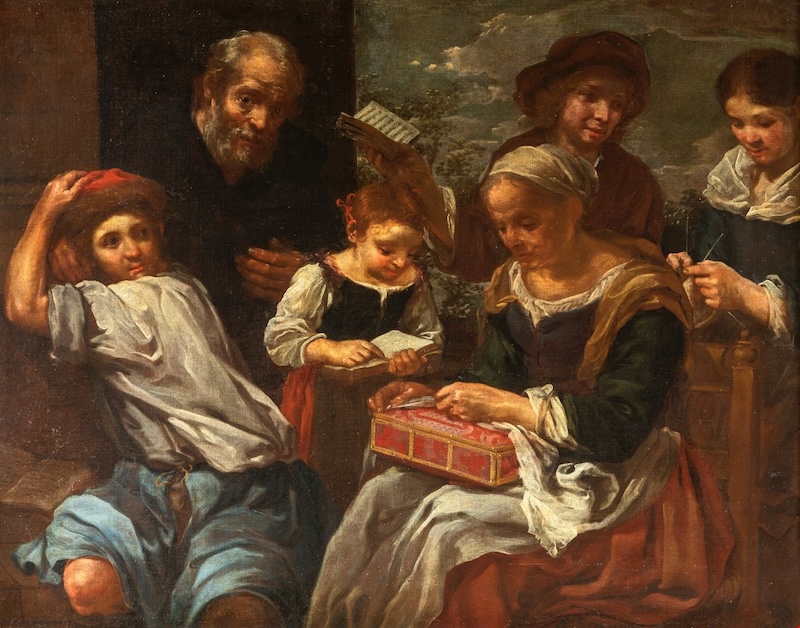
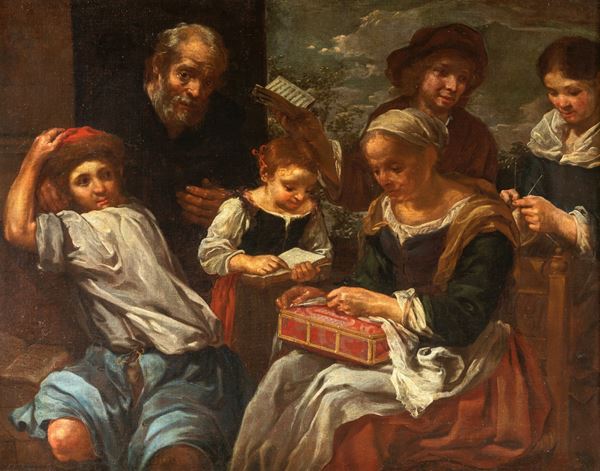
Occupazioni domestiche - Allegoria della Vita
Noto in Italia come Monsù Bernardo, pittore danese e discepolo di Rembrandt, operò in numerosi centri artistici europei, [..]
Sold
Eberhard o Bernhard Keilhau, detto Monsù Bernardo
(Helsingør , 1624 - Roma, 1687)
in the manner of
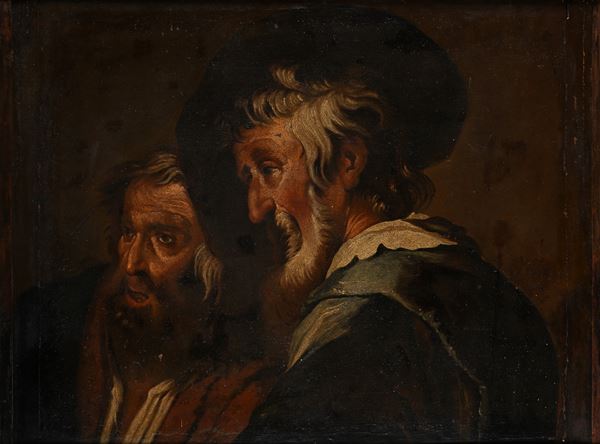
Cena in Emmaus (dettaglio)
Si tratta di un dettaglio di un dipinto che raffigura un episodio tratto dal Vangelo di Luca. Dopo la Resurrezione, due [..]