

Evaluation Alessandro Magnasco
Alessandro Magnasco Valuations - Want to sell a Alessandro Magnasco piece? Request a complimentary and confidential valuation!Casa d'Aste Arcadia will review your submission and offer a free-of-charge estimate, if your item is suitable for our auctions.
biography
Alessandro Magnasco, known as il Lissandrino, was born in Genoa on February 4, 1667, to Livia Caterina Musso and painter Stefano, a student of Valerio Castello. Following his father's death, Magnasco was entrusted to a Genoese merchant who brought him to Milan around 1682, where he entered the workshop of Filippo Abbiati. In the Lombard city, Magnasco absorbed the influences of contemporary Venetian painting, characterized by thick, layered brushwork and violent chromatic and luministic contrasts, while also being impressed by the work of Marco Ricci. Initially dedicated to portrait painting, he soon abandoned this practice to develop a personal and innovative artistic style.
From 1703 to 1711, Magnasco settled in Florence, entering the service of Grand Duke Ferdinando de' Medici. At the Medici court, he was particularly influenced by studying the works of Stefano della Bella, Jacques Callot, Salvator Rosa, Giuseppe Maria Crespi, and Giovanni Domenico Ferretti. During this period, the painter developed his characteristic genre painting, definitively abandoning traditional religious painting to dedicate himself to the representation of everyday and popular scenes. In 1708 he married Maria Rosa Caterina Borea in Genoa, and in 1709, following the birth of his firstborn daughter Livia Caterina, he returned to Milan.
Returning to Milan in 1711, Magnasco was commissioned to execute the decoration for the triumphal entry of Emperor Charles VI. In the following years, he worked for various private Milanese patrons and for Count Colloredo, the Austrian governor of the city, creating works of great social and ironic impact. His compositions were characterized by brushstrokes dense with luminous contrasts, elongated and distorted figures of friars, gypsies, woodcutters, and acrobats inserted into dark, stormy, and gloomy scenarios. Among his most representative works are Gathering of Quakers, Procession of Capuchins, The Library of the Capuchins, The Interrogation, The Embarkation of Galley Slaves, Hot Chocolate, Refection of Gypsies, Friars in Prayer, Catechism Lesson, and Synagogue.
In 1735 Magnasco made his definitive return to his native city, Genoa, where he continued to paint until the end of his life. During this period, he created the celebrated Entertainment in a Garden of Albaro, preserved in the Gallery of Palazzo Bianco, considered one of his most famous masterpieces and a merciless portrait of decadent Genoese aristocracy. Toward the end of his life, he worked as a figurist in the service of Antonio Francesco Peruzzini and Clemente Spera, collaborators who assisted him in the realization of architectural elements and ruins. Considered one of the most original painters of the Italian eighteenth century, Magnasco distinguished himself for his ability to unite energetic and vibrant pictorial language with an intense and sometimes pitiless vision of the world. His work anticipated Romantic and Expressionist painting of later centuries, bringing him close to visionary spirits such as Monsù Bernardo and El Greco. Magnasco died in Genoa on March 12, 1749, leaving an artistic legacy of extraordinary originality and nonconformism.
From 1703 to 1711, Magnasco settled in Florence, entering the service of Grand Duke Ferdinando de' Medici. At the Medici court, he was particularly influenced by studying the works of Stefano della Bella, Jacques Callot, Salvator Rosa, Giuseppe Maria Crespi, and Giovanni Domenico Ferretti. During this period, the painter developed his characteristic genre painting, definitively abandoning traditional religious painting to dedicate himself to the representation of everyday and popular scenes. In 1708 he married Maria Rosa Caterina Borea in Genoa, and in 1709, following the birth of his firstborn daughter Livia Caterina, he returned to Milan.
Returning to Milan in 1711, Magnasco was commissioned to execute the decoration for the triumphal entry of Emperor Charles VI. In the following years, he worked for various private Milanese patrons and for Count Colloredo, the Austrian governor of the city, creating works of great social and ironic impact. His compositions were characterized by brushstrokes dense with luminous contrasts, elongated and distorted figures of friars, gypsies, woodcutters, and acrobats inserted into dark, stormy, and gloomy scenarios. Among his most representative works are Gathering of Quakers, Procession of Capuchins, The Library of the Capuchins, The Interrogation, The Embarkation of Galley Slaves, Hot Chocolate, Refection of Gypsies, Friars in Prayer, Catechism Lesson, and Synagogue.
In 1735 Magnasco made his definitive return to his native city, Genoa, where he continued to paint until the end of his life. During this period, he created the celebrated Entertainment in a Garden of Albaro, preserved in the Gallery of Palazzo Bianco, considered one of his most famous masterpieces and a merciless portrait of decadent Genoese aristocracy. Toward the end of his life, he worked as a figurist in the service of Antonio Francesco Peruzzini and Clemente Spera, collaborators who assisted him in the realization of architectural elements and ruins. Considered one of the most original painters of the Italian eighteenth century, Magnasco distinguished himself for his ability to unite energetic and vibrant pictorial language with an intense and sometimes pitiless vision of the world. His work anticipated Romantic and Expressionist painting of later centuries, bringing him close to visionary spirits such as Monsù Bernardo and El Greco. Magnasco died in Genoa on March 12, 1749, leaving an artistic legacy of extraordinary originality and nonconformism.
Past lots of Alessandro Magnasco
Alessandro Magnasco
(Genova, 1667 - Genova, 1749)
Attributed to
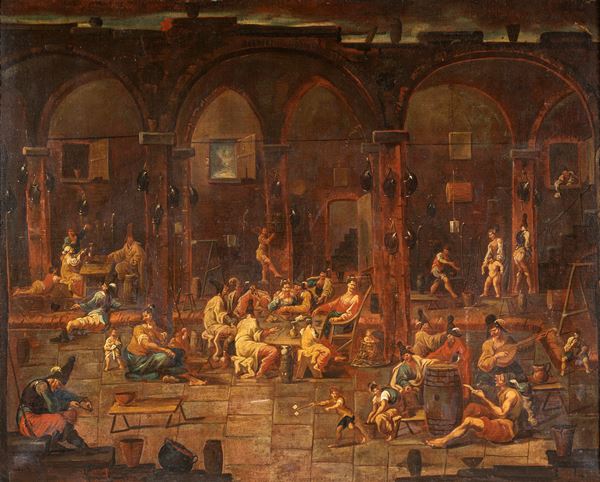
Alessandro Magnasco (attributed to) (Genoa 1667 - Genoa 1749) Interior scene with figures
An interior scene narrated with vivacity and a subtle sense of irony, inviting the gaze to wander among the numerous characters [..]
Sold
Alessandro Magnasco
(Genova, 1667 - Genova, 1749)
Attributed to
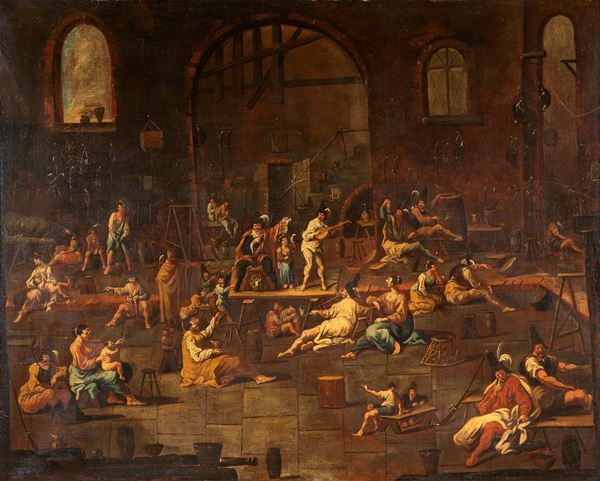
Alessandro Magnasco (attributed to) (Genoa 1667 - Genoa 1749) Interior scene with figures
A large interior scene set in a severe and monumental architectural space, animated by a crowd of figures captured in disorderly [..]
Sold
Alessandro Magnasco
(Genova, 1667 - Genova, 1749)
Sphere of
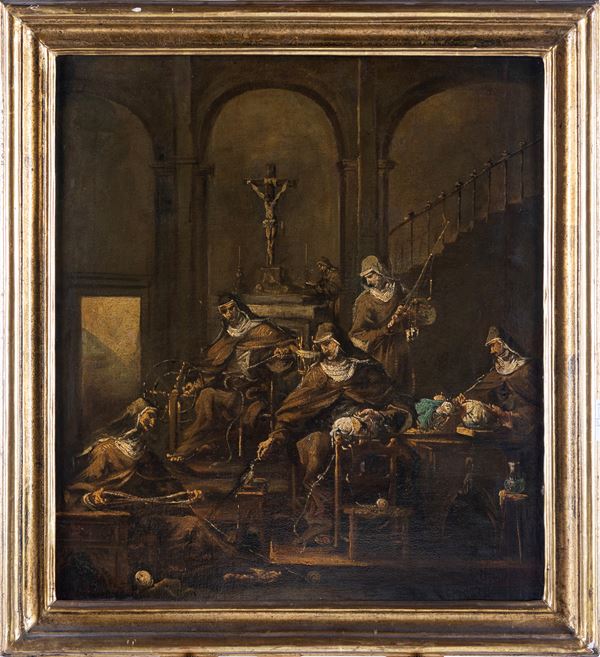
Monache merlettaie a lavoro
Olio su tela cm 45,5x40 - in cornice: cm 55x50
Sold