
57
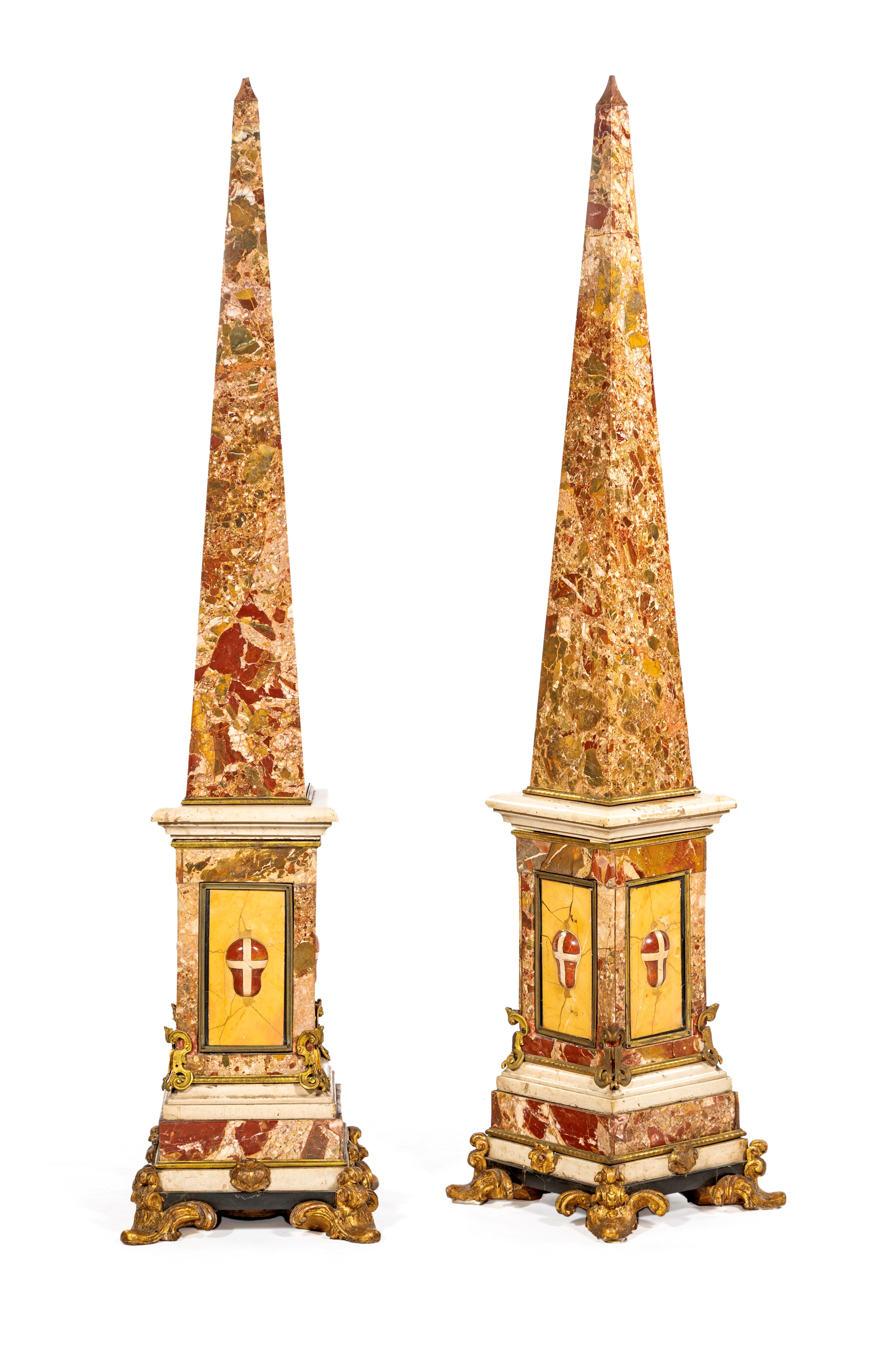
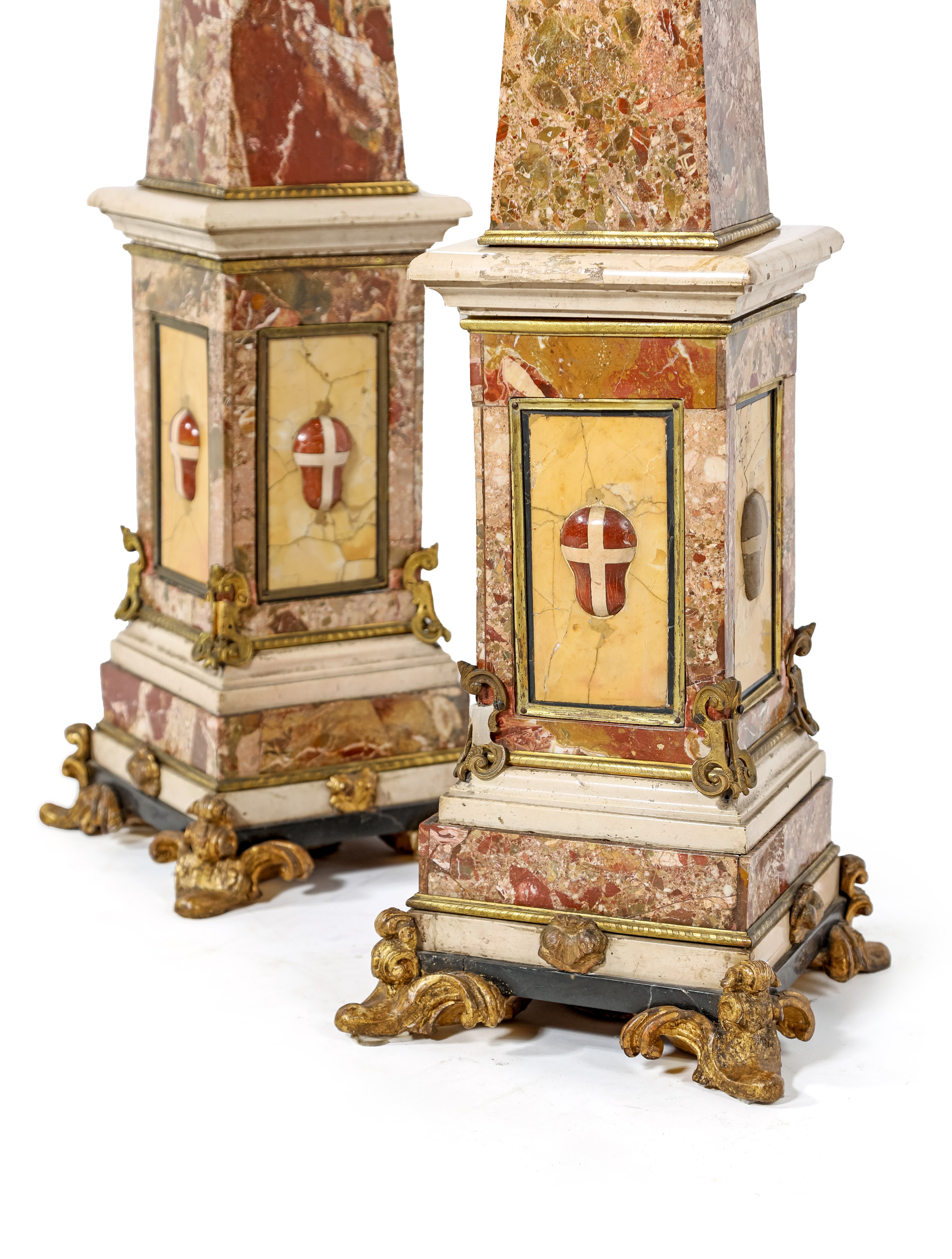
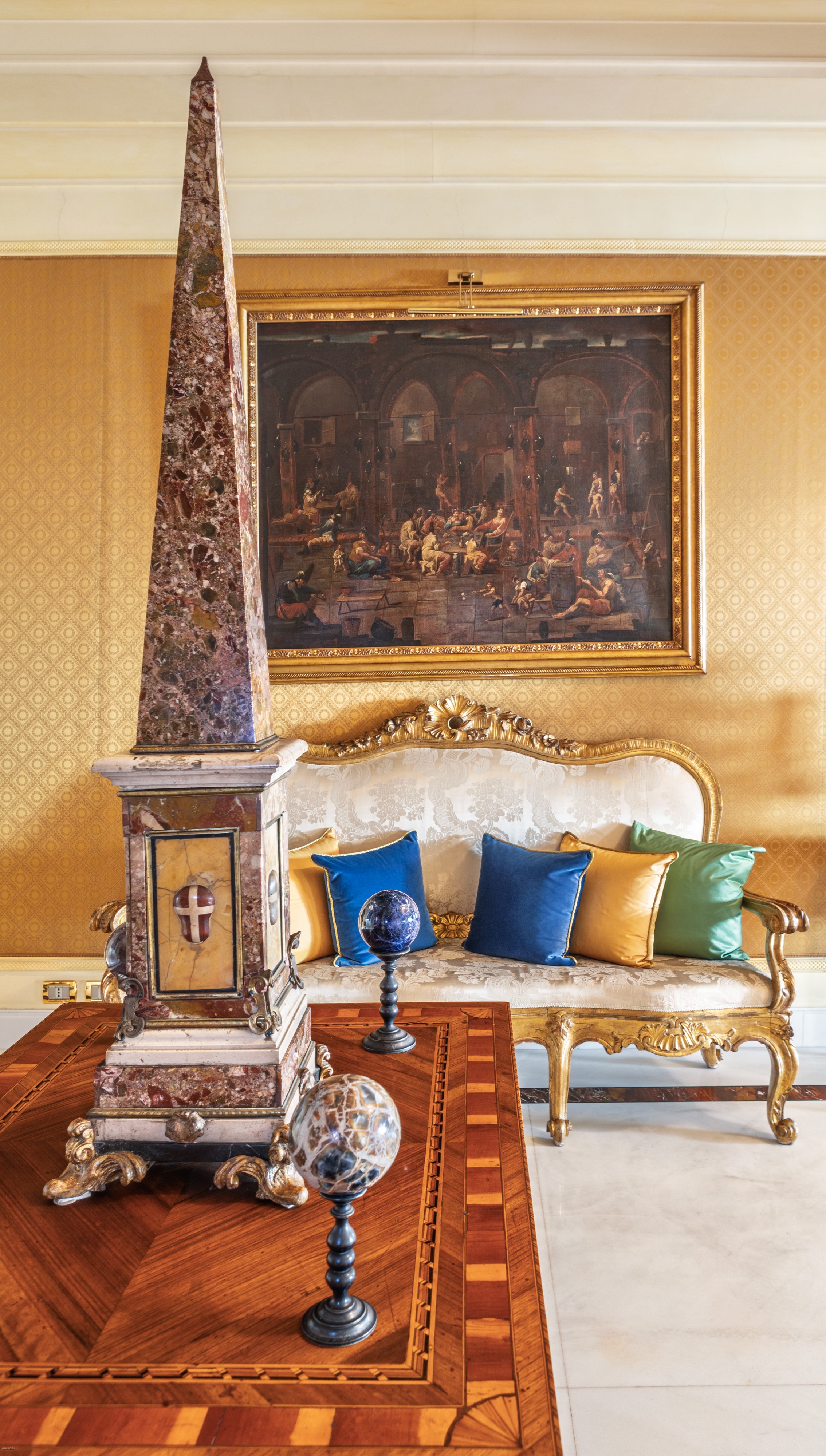
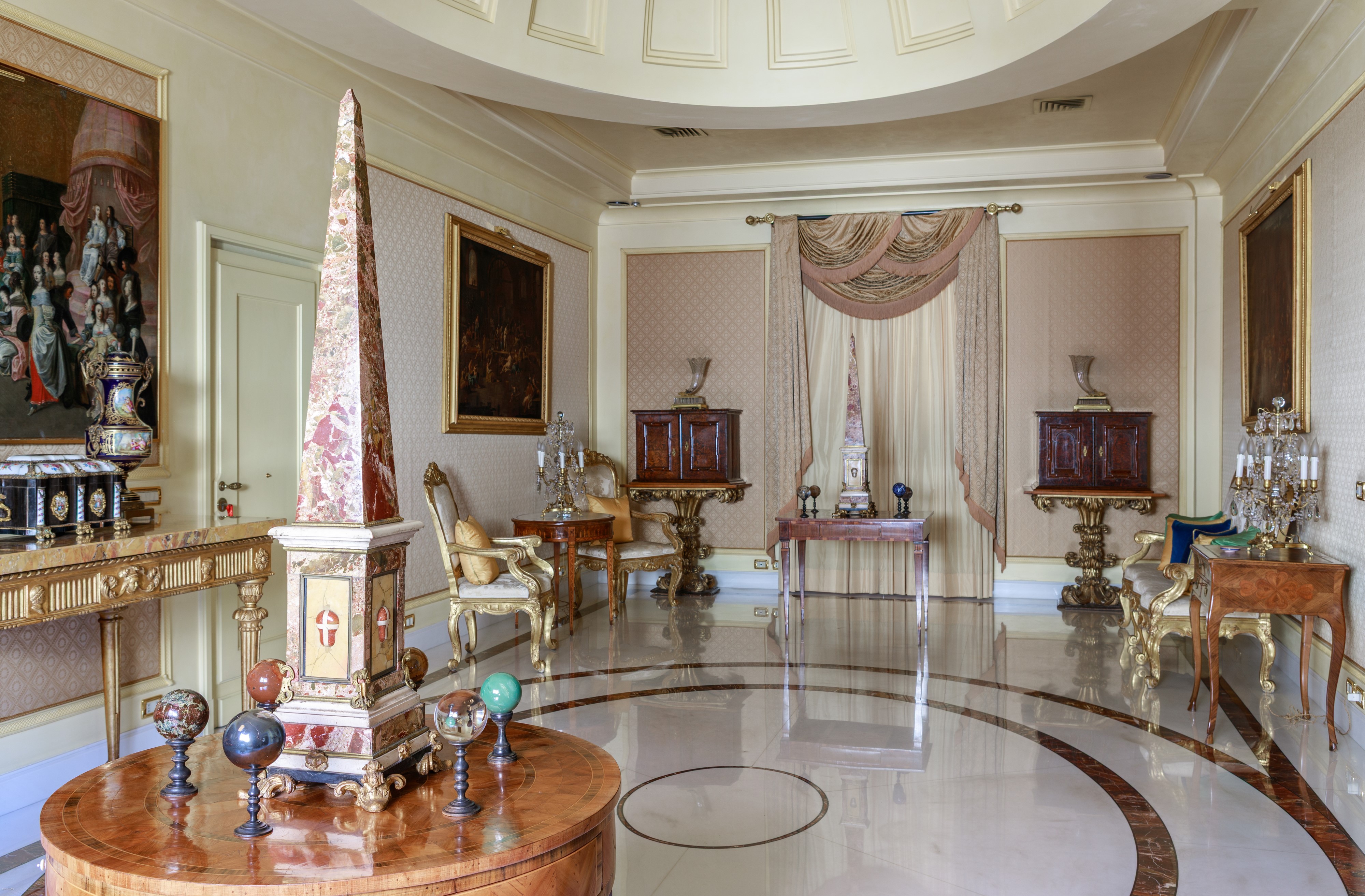
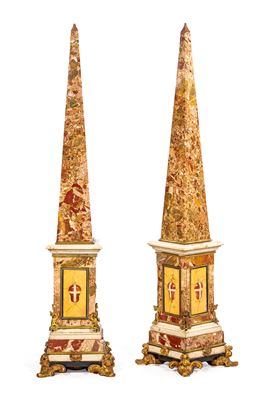
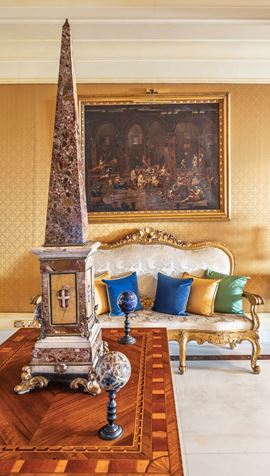
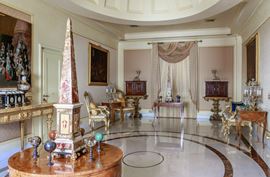
Pair of large obelisks in precious marble, Roman manufacture commissioned by the Savoy family, late 17th/early 18th century
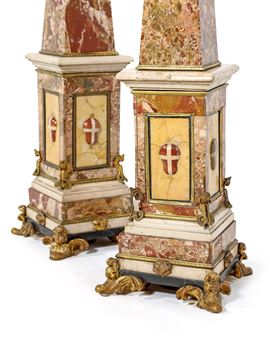
The slender, square-section pyramidal shafts, crafted from African breccia, rest on multi-tiered architectural bases, punctuated by square panels featuring the Savoy coat of arms, featuring a white cross on a convex shield in rosso antico marble, set against yellow antico marble panels. The bases are further embellished with finely chiseled gilded bronze applications, featuring volutes and foliage.
This pair of obelisks can likely be traced back to a noble commission with ties to the Savoy family between the late 17th and 18th centuries, at a time when the House of Savoy was consolidating its political and symbolic role in Europe. In this context, numerous aristocratic families, court officials, high-ranking military personnel, and ecclesiastical dignitaries operating in the Savoy territories adopted iconographic elements attributable to the ruling dynasty as a sign of loyalty, belonging, and social legitimacy. The use of the white cross on a red field, the distinctive emblem of the House of Savoy, appears here in a deliberately simplified and isolated form, devoid of a crown, knightly collars, or other official dynastic attributes. This choice suggests a symbolic use, not an affirmation of belonging to the ruling House, but a declaration of loyalty and political support. It is plausible that the commissioning family, active in Piedmont or other territories subject to the House of Savoy, turned to a high-end workshop, perhaps Roman, where the workmanship of polychrome marble "in the ancient style" was particularly refined. Rome was, in fact, the privileged center for this type of production, and many works destined for the Savoy residences were executed there and then transported to Turin or other noble residences.
From this perspective, the obelisks emerge as a visual manifesto of dynastic loyalty and cultural adherence to the language of Baroque magnificence, in which the reference to classicism, the use of precious materials, and the presence of a clearly recognizable emblem contribute to defining the client's identity and ambitions. The Savoy cross, reduced to its essential symbol, thus becomes not only a heraldic symbol, but a discreet yet unmistakable political and cultural signal. 117 x 27 x 27 cm
cm 117x27x27
Live auction 203
Furnishings and Paintings | The Timeless Elegance of an Important Roman Mansion
Rome, Palazzo Celsi, wed 4 March 2026
SINGLE SESSION 04/03/2026 Hours 15:00
The condition of the goods is not always indicated in the description sheets; we encourage you to always request the condition report before placing your bids.
Please note that in a live auction, bids submitted via the web are confidential and not visible to other participants; therefore, they may not win bids at the time of the auction.
New lots currently at auction
Private Collections - Antique Furniture, [..]
Lot 185
Pair of Sèvres blue porcelain and gilt bronze vases, 19th century
Private Collections - Antique Furniture, [..]
Lot 31
Cestino ovale in terraglia, fine XVIII secolo
Private Collections - Antique Furniture, [..]
Lot 169
"Nodding magot" in porcellana monocroma, manifattura europea, Germania (?), XIX secolo
Private Collections - Antique Furniture, [..]
Lot 45
Pettorale di corazza in rame sbalzato, XVI/XVII secolo
Private Collections - Antique Furniture, [..]
Lot 154
Tavolino a libretto, fine del XVIII/inizi del XIX secolo
Private Collections - Antique Furniture, [..]
Lot 171
Centrotavola in porcellana cinese di Canton con montatura in bronzo dorato, Francia, seconda metà del [..]
Private Collections - Antique Furniture, [..]
Lot 28
Coppia di bottiglie in maiolica bianca e blu, Savona, XVIII secolo
Private Collections - Antique Furniture, [..]
Lot 92
Tavolino basso con piano in marmo, Sicilia, fine del XVIII secolo
Private Collections - Antique Furniture, [..]
Lot 20
Scultura in marmo raffigurante il dio Nettuno
Private Collections - Antique Furniture, [..]
Lot 197