
20
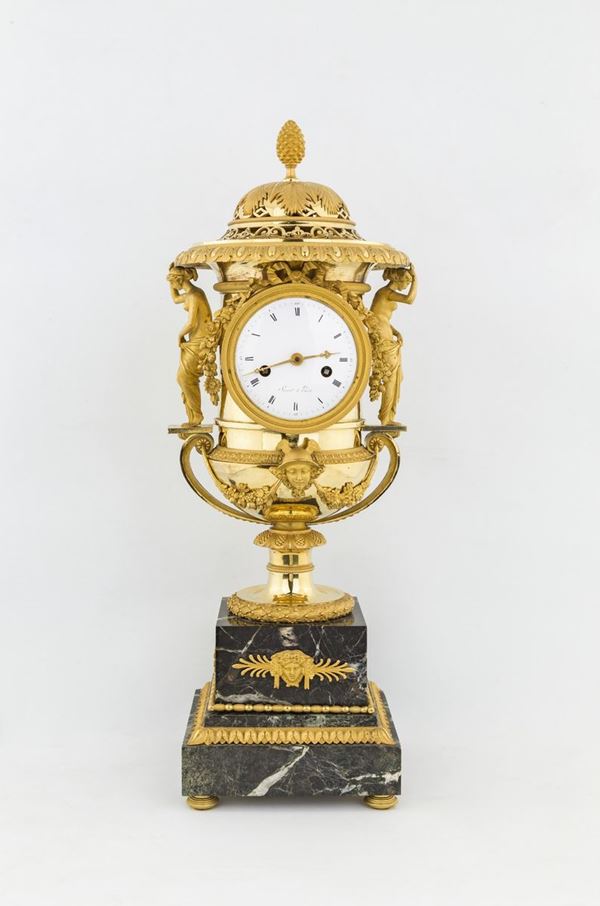
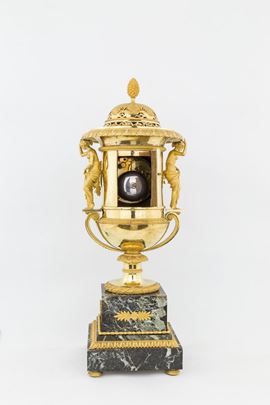
Large gilt bronze clock, France, Directory period.
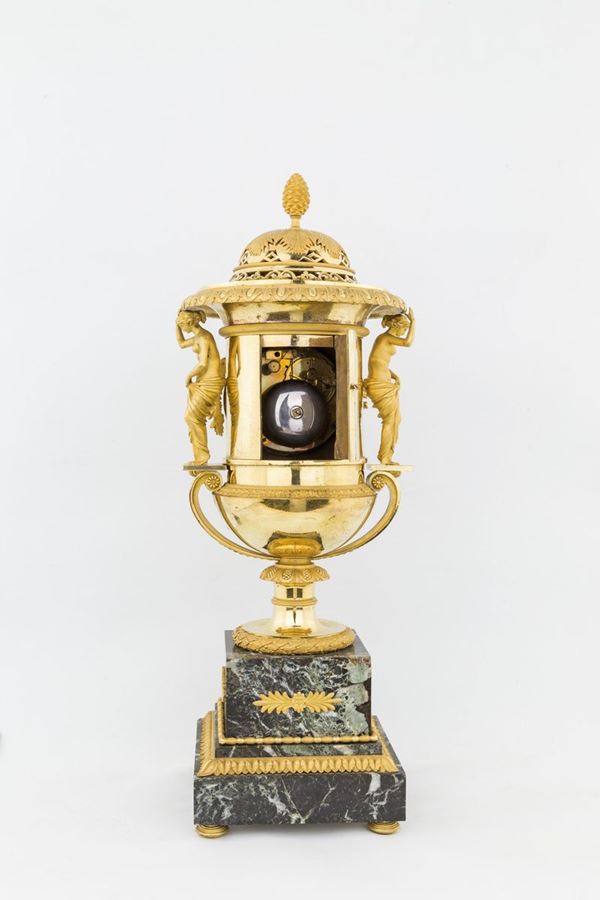
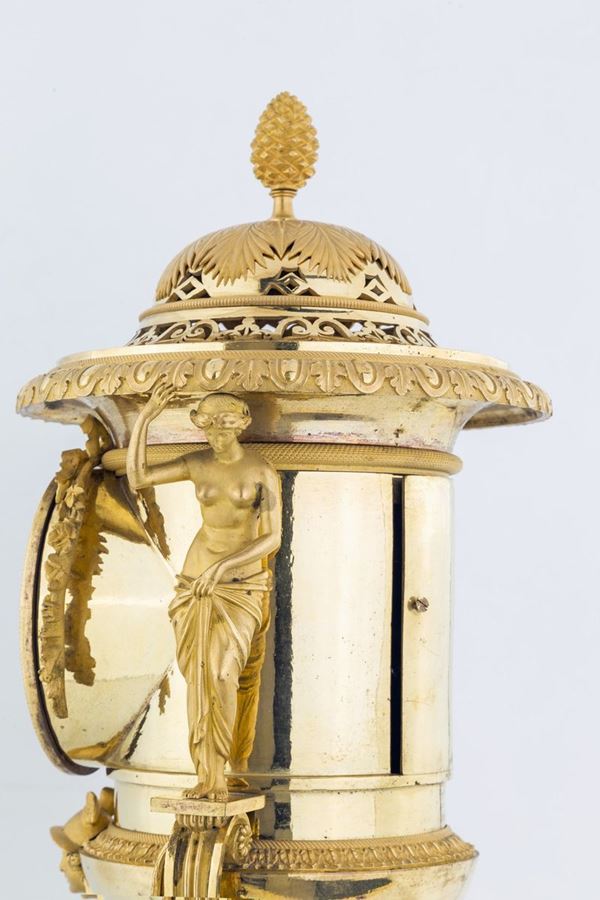
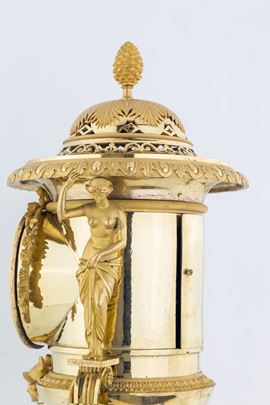
in the form of a Medici vase embellished with naturalistic friezes of neoclassical taste and characterized by female figures placed on the handles; these depart from the junction of the foot at the base of the vase decorated with the face of Mercury among meticulously chiseled garlands. Partially perforated dome lid surmounted by a pine cone, squared base in marble embellished frontally by a mask. Double barrel movement with silk suspension and bell made by the Parisian watchmaker Sirost (as signed on the dial), who had his business in Rue Bertin-Poiré between 1806-1810 and later in Rue des Fontaines in 1840.
This refined timepiece takes up the well-known Sèvres porcelain model created by the French sculptor Louis-Simon Boizot (1743-1809) and by the bronze artist Pierre-Philippe Thomire (1751 -1843) commissioned by the Count d'Angiviller (the man who created the Louvre) of the Garde-Meuble de la Couronne and delivered to Louis XVI and Marie Antoinette at Versailles in 1783.
A clock similar to this example was supplied to the Château de Fontainebleau on 23 August 1806 (JP Samoyault, Pendules et bronzes d'ameublement entrés sous le Premier Empire, Paris 1989, cat. 47, p. 81), while two further examples are found at the Musée Francois-Duesberg, Mons in Belgium (P. Kjellberg, Encyclopédie de la pendule Francaise, Paris 1997, p. 327, fig. C)
See for further comparison: Giacomo Wannenes, The most beautiful French clocks from Louis XIV to the Empire, Leonardo editore Milano 1991, p. 160
cm 58x18x18
€ 15.000,00 / 18.000,00
Estimate